Performance
Voice actors and performance
- Joji Nakata - Japanese (2001 television anime and Hellsing Ultimate)
Performance credits are listed by release language and checked against the cited release sources.
Complete character analysis
Story, powers and development
Story spoilers ahead
The spoiler-safe introduction appears above. The sections below connect personality and abilities to relationships, defining moments, adaptation choices and current status.
Character study
Personality and motivation
- Theatrical
- Battle-hungry
- Proud
- Loyal to Integra's authority
Power system
Abilities, powers and limitations
Abilities
- Extreme regeneration and resistance to conventional injury
- Shapeshifting into shadow, mist and other monstrous forms
- Superhuman strength, speed and perception
- Using large-calibre pistols, familiars and progressively released restraints
Limits
- Hellsing's control system and Integra's orders govern when Alucard may release the full extent of his abilities.
- Pride and the desire for a worthy opponent can make him prolong confrontations instead of ending them efficiently.
- Immense regenerative power does not remove the psychological burden of identity, memory or accumulated lives.
Character connections
Important relationships
- Integra Hellsing is Alucard's master and commanding officer; their bond rests on her refusal to be intimidated and his recognition of deliberate human authority.
- Seras Victoria becomes a vampire through Alucard's intervention, and he watches whether she will accept her new nature through choice rather than surrender.
- Alexander Anderson is an ideological enemy and desired opponent whose human conviction matters to Alucard as much as his supernatural weapons.
Story progression
Defining moments
- Waiting for Integra to issue an explicit order before escalating a mission establishes that even Hellsing's strongest weapon operates through command.
- Offering Seras a choice at the edge of death begins a mentorship built around whether she can claim vampiric existence as her own.
- Removing restraint levels transforms Alucard from a gunfighter into a mass of stored horror, making visible the history contained inside his power.
Visual language
Symbolism and visual design
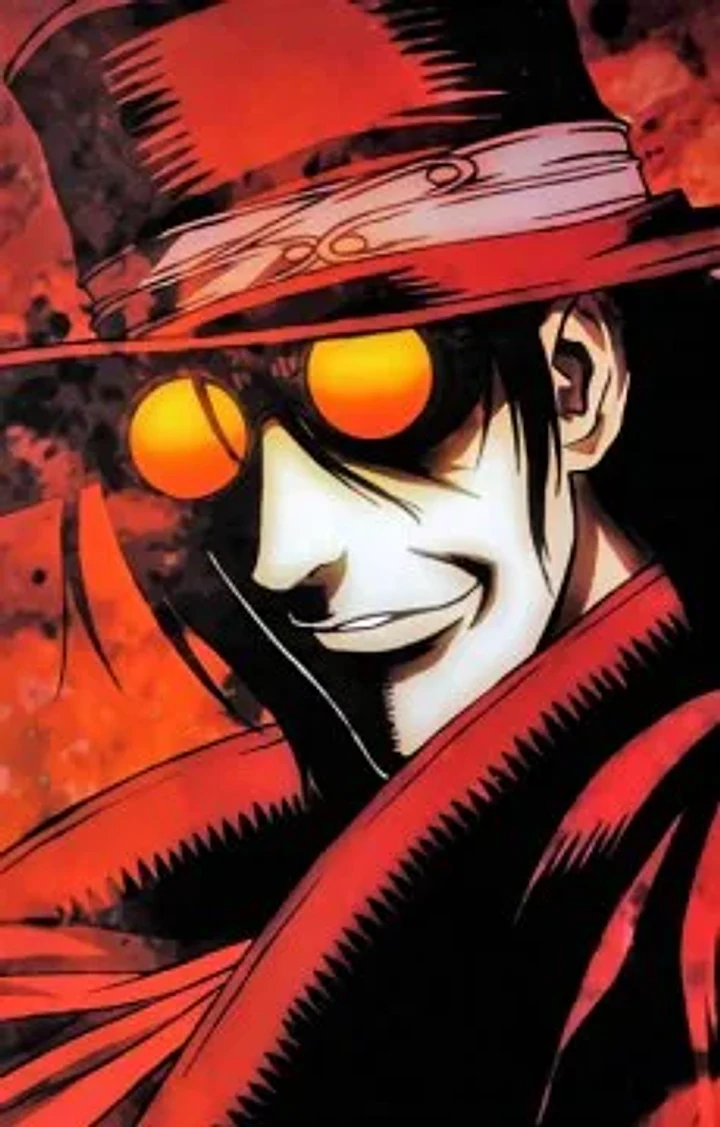
The red coat and hat give Alucard the theatrical outline of a wandering gunslinger while making blood and aristocratic display part of the same image.
Tinted glasses hide his eyes until restraint gives way, using visibility to distinguish controlled servant from predatory force.
The seals on his gloves and weapons turn obedience into a physical design language: power is always shown beside the system attempting to contain it.
Adaptation notes
Manga versus anime
Kouta Hirano's manga is the source continuity. Hellsing Ultimate follows its major conflict and structure much more closely, while the 2001 television anime develops an original latter half because the manga was unfinished during production.
The two anime versions therefore should not be combined into one event history. Their tone, antagonists and outcomes differ even though Joji Nakata voices Alucard in Japanese in both.
Spoiler section
Ending and current status
The main profile avoids end-of-series outcomes and late identity or relationship reveals.
Ending and current-status coverage will only appear inside a dedicated, clearly labelled spoiler section.