Performance
Voice actors and performance
- Kaito Ishikawa — Japanese
Performance credits are listed by release language and checked against the cited release sources.
Complete character analysis
Story, powers and development
Story spoilers ahead
The spoiler-safe introduction appears above. The sections below connect personality and abilities to relationships, defining moments, adaptation choices and current status.
Character study
Personality and motivation
- Earnest
- Intense
- Literal-minded
- Obsessively self-improving
Power system
Abilities, powers and limitations
Abilities
- Modular cyborg body
- Incineration cannons
- High-speed movement
- Advanced sensors and combat analysis
Limits
- High-output attacks rapidly consume energy and can overheat or damage components.
- A replaceable body encourages tactical choices that undervalue his own survival.
- Fixation on upgrades can substitute greater firepower for understanding why a previous approach failed.
Character connections
Important relationships
- Saitama becomes Genos's teacher despite offering little formal instruction, challenging his assumption that strength always has an explainable method.
- Dr. Kuseno rebuilds and supports Genos, connecting mechanical improvement to patient care rather than vengeance alone.
- The destructive cyborg he seeks remains an organising absence, giving Genos a purpose that cannot provide companionship or closure by itself.
Story progression
Defining moments
- Witnessing Saitama end a threat effortlessly convinces Genos to seek apprenticeship instead of another hardware answer.
- Entering the Hero Association demonstrates that formal rank can recognise spectacular ability while still missing what he hopes to learn.
- Continuing to fight after severe damage shows courage and the dangerous ease with which he treats his body as expendable equipment.
Visual language
Symbolism and visual design
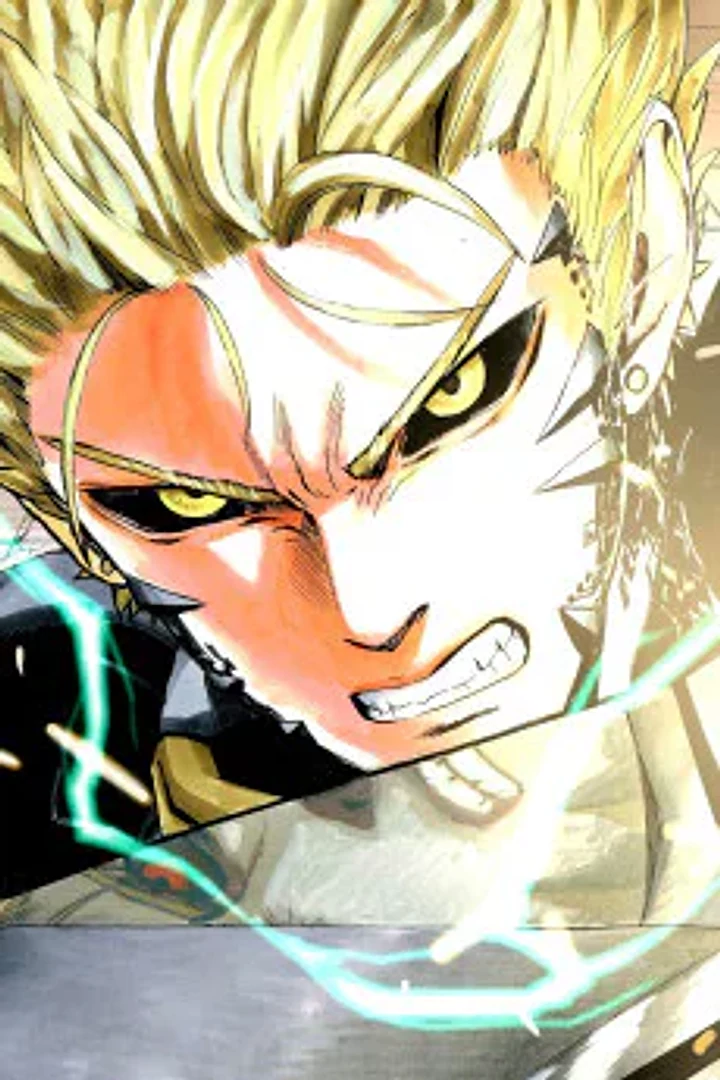
Highly detailed mechanical limbs contrast with Saitama's simple design, placing visible effort beside strength that looks effortless.
A glowing core makes power, vulnerability and the boundary between human purpose and replaceable machinery occupy the same visual centre.
Adaptation notes
Manga versus anime
The manga's dense mechanical art can pause on individual components, while animation turns boosters, recoil and disassembly into continuous spatial action.
Kaito Ishikawa's grave delivery preserves Genos's sincerity even when literal devotion to Saitama becomes the joke.
Spoiler section
Ending and current status
The main profile avoids end-of-series outcomes and late identity or relationship reveals.
Ending and current-status coverage will only appear inside a dedicated, clearly labelled spoiler section.