Performance
Voice actors and performance
- Yuichi Nakamura — Japanese
Performance credits are listed by release language and checked against the cited release sources.
Complete character analysis
Story, powers and development
Story spoilers ahead
The spoiler-safe introduction appears above. The sections below connect personality and abilities to relationships, defining moments, adaptation choices and current status.
Character study
Personality and motivation
- Playful
- Provocative
- Protective
- Strategically idealistic
Power system
Abilities, powers and limitations
Abilities
- Limitless cursed technique
- Six Eyes
- Domain Expansion
- Advanced reverse cursed technique
Limits
- Exceptional individual power cannot reform institutions on its own.
- His reputation changes how allies and enemies behave, making ordinary trust difficult.
- Protecting several people or objectives at once can create strategic constraints even when a direct duel would favour him.
Character connections
Important relationships
- Yuji represents Gojo's refusal to let the jujutsu hierarchy decide a young person's value in advance.
- Megumi connects his role as teacher to older clan politics and to the question of how talent should be nurtured.
- Suguru Geto is essential to understanding why Gojo values strong allies and why strength without shared purpose feels isolating.
Story progression
Defining moments
- Taking responsibility for Yuji establishes his willingness to challenge official orders.
- Training students through experience rather than obedience shows the educational side of his rebellion.
- Confrontations with special-grade threats reveal that his greatest dramatic problem is often not whether he can win, but what his power cannot protect simultaneously.
Visual language
Symbolism and visual design
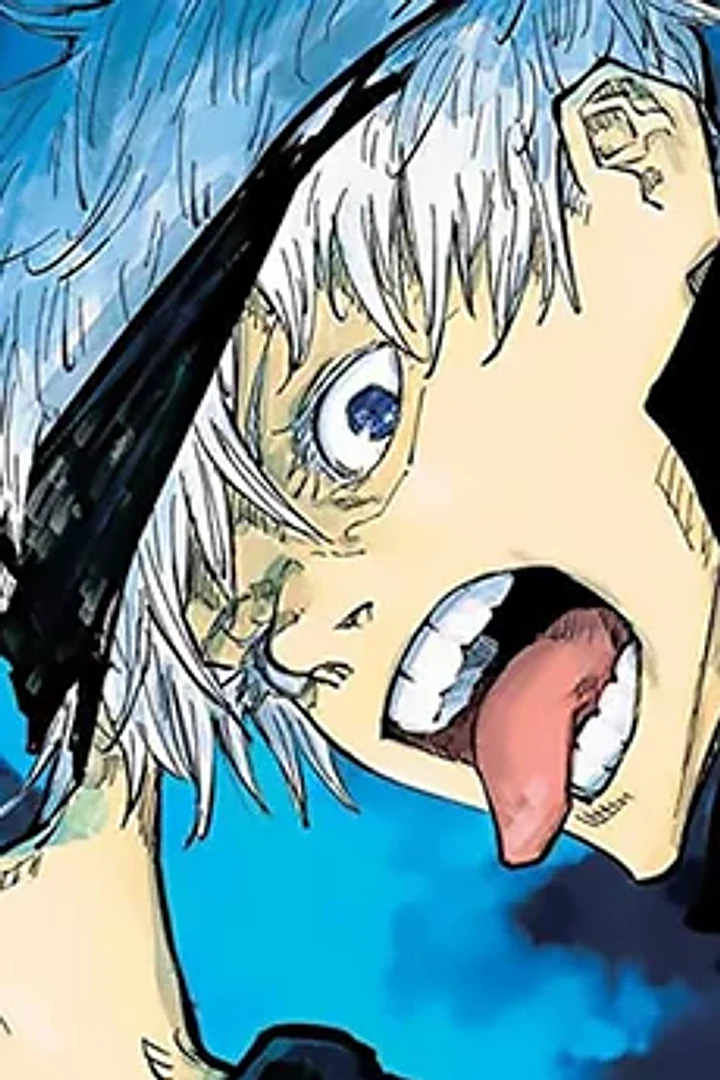
The blindfold and covered eyes turn perception into a deliberate visual question: Gojo sees more than almost anyone while choosing how much of himself others can read.
His relaxed posture contrasts with the precision of his technique, reinforcing the gap between apparent frivolity and constant calculation.
Adaptation notes
Manga versus anime
The anime uses spatial distortion, sound design and changes in visual scale to make an abstract technique immediately legible.
The manga can place more emphasis on the conceptual rules of an exchange, while animation adds timing and physical atmosphere.
Spoiler section
Ending and current status
The main profile avoids end-of-series outcomes and late identity or relationship reveals.
Ending and current-status coverage will only appear inside a dedicated, clearly labelled spoiler section.