Performance
Voice actors and performance
- Takehito Koyasu - Japanese
Performance credits are listed by release language and checked against the cited release sources.
Complete character analysis
Story, powers and development
Story spoilers ahead
The spoiler-safe introduction appears above. The sections below connect personality and abilities to relationships, defining moments, adaptation choices and current status.
Character study
Personality and motivation
- Predatory
- Opportunistic
- Persistent
- Willing to attack from behind
- Focused on vulnerable souls rather than difficult opponents
Power system
Abilities, powers and limitations
Abilities
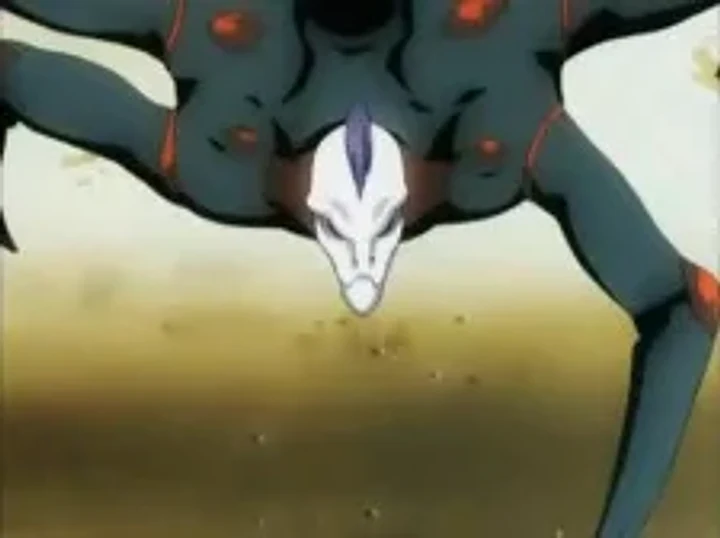
- Moving rapidly across the ground on six insect-like legs
- Tracking and pursuing a young Plus through a public park
- Using multiple limbs and a low body position to surround or overrun prey
- Continuing an attack after losing a foreleg
- Recognizing a pause in Ichigo's attention and attempting a rear assault
- Exerting enough spiritual presence to threaten a soul that cannot defend itself
Limits
- Hexapodus has no demonstrated named technique, ranged attack or unusual spiritual defense.
- Its hunting strategy favors a frightened child rather than a capable Soul Reaper.
- Ichigo can sever a limb with an ordinary swing of his unreleased Zanpakutō.
- The attempted surprise attack fails as soon as Ichigo senses movement behind him.
- One direct thrust through the mask is enough to complete purification.
Character connections
Important relationships
- Ichigo Kurosaki defeats Hexapodus while deciding whether his new power obligates him to protect souls he does not know.
- Rukia Kuchiki brings Ichigo to the scene and uses the threatened child to explain the daily responsibility of a Soul Reaper.
- The unnamed boy's Plus is Hexapodus's prey and the first stranger Ichigo deliberately saves in his new role.
- Fishbone D precedes this encounter and represents the family emergency that gave Ichigo power without yet settling how he would use it.
- Kisuke Urahara later equips Ichigo for more reliable separation from his body, a practical problem still unresolved during these first assignments.
- Karakura Town's other souls depend on patrol work like this even when their cases never become major battles.
Story progression
Defining moments
- Chasing a child through the park gives Rukia a clear example of the lives Soul Reaper patrols are meant to protect.
- Confronting Ichigo immediately after the power transfer tests whether his transformation was a one-time family response.
- Losing a foreleg shows how quickly the balance changes when the new Substitute Soul Reaper commits to a strike.
- Attacking while Ichigo speaks with Rukia reveals the limited cunning behind an otherwise direct predator.
- Being stabbed through the mask gives Ichigo a clean lesson in Hollow purification.
- Having its name revealed only later, when Rukia seeks payment for the job, turns a moral lesson back into the mundane administration of patrol work.
Visual language
Symbolism and visual design
Six legs give the Hollow speed and animal immediacy without granting it the emotional complexity of later enemies.
The children's park places spiritual predation inside a setting built for ordinary safety and play.
The unknown victim expands Ichigo's protective circle beyond family and friends.
Hexapodus's delayed name reflects how routine threats can be personally terrifying to victims while remaining paperwork to an institution.
Adaptation notes
Manga versus anime
The manga keeps Hexapodus's attack compact and uses it mainly for Ichigo and Rukia's argument about the obligations attached to Soul Reaper power.
The anime gives the chase and conversation more screen time while preserving the quick purification and absence of a special named ability. Takehito Koyasu voices Hexapodus in Japanese.
Spoiler section
Ending and current status
The main profile avoids end-of-series outcomes and late identity or relationship reveals.
Ending and current-status coverage will only appear inside a dedicated, clearly labelled spoiler section.