Performance
Voice actors and performance
Performance credits are listed by release language and checked against the cited release sources.
Complete character analysis
Story, powers and development
Story spoilers ahead
The spoiler-safe introduction appears above. The sections below connect personality and abilities to relationships, defining moments, adaptation choices and current status.
Character study
Personality and motivation
- Stern
- Protective
- Melancholic
- More emotionally direct than Old Man Zangetsu
- Determined to resist Ichigo's self-sacrifice
Power system
Abilities, powers and limitations
Abilities
- Manifesting when Ichigo enters his inner world in Bankai and reflecting that compressed state through a younger form
- Using exceptional speed and swordsmanship appropriate to Tensa Zangetsu's combat style
- Reading the state of Ichigo's inner world and explaining how despair has submerged its buildings
- Drawing White Zangetsu out of Ichigo and restraining the violent Hollow form
- Merging with White Zangetsu into a single figure that embodies both internal sources of power
- Transmitting the Final Getsuga Tensho after Ichigo accepts the merged blade instead of trying to dominate it
Limits
- Tensa Zangetsu exists inside Ichigo and cannot solve the external battle with Aizen independently.
- He refuses direct instruction because the Final Getsuga Tensho will erase Ichigo's Soul Reaper power and make the spirit disappear.
- His protective goal conflicts with Ichigo's willingness to sacrifice his own future for people in immediate danger.
- The merged spirit can test Ichigo's readiness but cannot make him understand acceptance through force alone.
- His apparent identity remains incomplete until the Thousand-Year Blood War explains the Quincy and Hollow sources behind both inner figures.
Character connections
Important relationships
- Ichigo Kurosaki seeks Tensa's ultimate technique, while Tensa resists because he values Ichigo's continued life and power above the requested victory.
- White Zangetsu is the Hollow-Soul Reaper spirit Tensa draws out and joins, revealing that Ichigo's internal powers can act as one being.
- Old Man Zangetsu is Tensa's older Shikai-state appearance and shares the same protective attachment to Ichigo.
- Isshin Kurosaki sends Ichigo into the Dangai training after using a related method to learn his own Final Getsuga technique.
- Sosuke Aizen is the external threat whose evolution makes Ichigo willing to accept the permanent cost Tensa fears.
- Yhwach is the ancestral figure whose younger appearance Tensa resembles, a connection explained only much later.
Story progression
Defining moments
- Appearing as a younger man immediately challenges Ichigo's assumption that Zangetsu has one fixed form.
- Showing the submerged inner city translates Ichigo's despair into a landscape he can no longer ignore.
- Refusing to teach the technique reveals that the spirit's goal is not identical to the goal of the person wielding him.
- Pulling White Zangetsu from Ichigo's body forces the two feared powers into the same conversation.
- Merging with White demonstrates that Hollow and Quincy manifestations can cooperate even while Ichigo still divides them.
- Letting Ichigo receive the blade through acceptance grants the Final Getsuga Tensho and foreshadows the meaning of 'the blade is me.'
Visual language
Symbolism and visual design
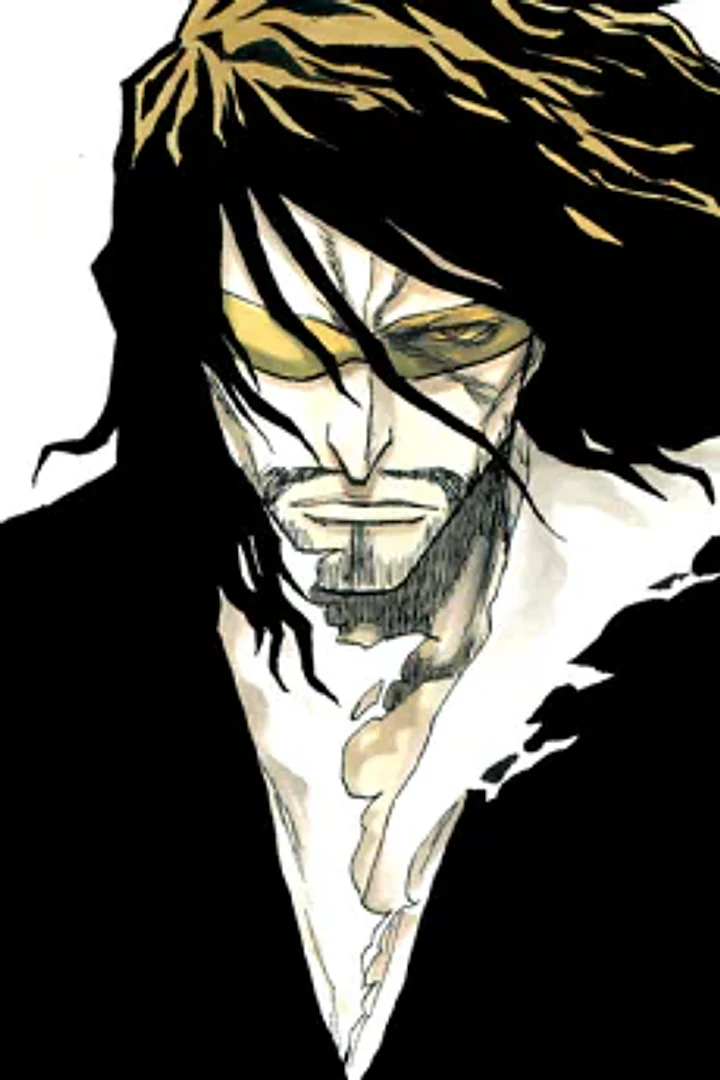
Tensa's younger face represents power compressed by Bankai while quietly foreshadowing the age-based resemblance to Yhwach.
The drowned city makes despair a rising physical force that erases the stable ground of Ichigo's inner world.
His crossed blades and eventual fusion show that identities presented as rivals can belong to the same self.
The technique that makes Ichigo become Getsuga turns mastery from possessing a weapon into accepting unity with it.
Adaptation notes
Manga versus anime
The manga presents Tensa Zangetsu primarily through the Dangai training and uses his youthful resemblance as a clue whose full meaning arrives in the final arc.
The anime extends the merged spirit's duel with Ichigo and emphasizes the flooded inner world through motion, reflection and sound. Takayuki Sugo voices Tensa Zangetsu in Japanese with a younger but recognizably connected performance.
Spoiler section
Ending and current status
The main profile avoids end-of-series outcomes and late identity or relationship reveals.
Ending and current-status coverage will only appear inside a dedicated, clearly labelled spoiler section.